After the Rope Drops: The Quiet Disillusionment That Follows Arrival at the Top
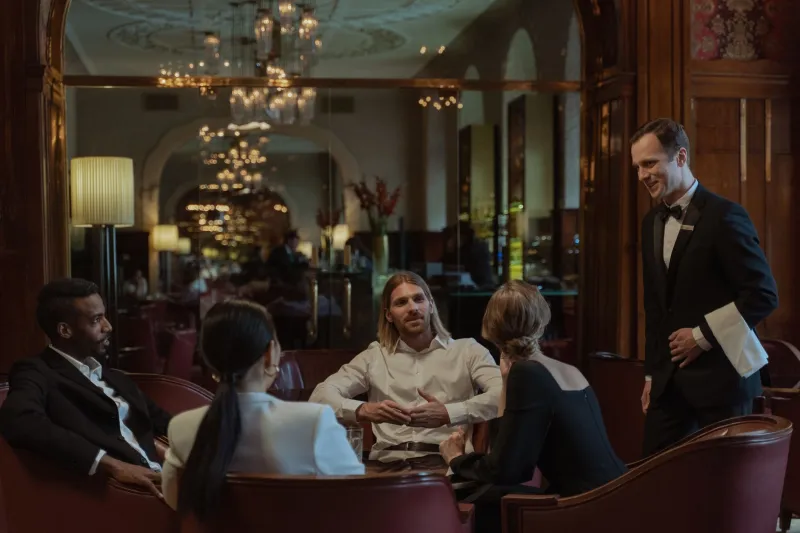
There is a particular silence that descends when you finally get what you have spent years pursuing. Not the silence of peace, exactly—more the silence of recalibration. The room is beautiful. The people are polished. The champagne is precisely what it was always rumored to be. And yet something feels slightly, inexplicably off. If you have ever stood inside a long-coveted space and felt a faint but undeniable deflation, you are not alone. You are, in fact, experiencing one of the most reliably documented phenomena in the psychology of achievement.
The velvet rope was never really about the room behind it.
The Neuroscience of Wanting More Than Having
The human brain is, at its core, a prediction engine—and it is dramatically better at generating desire than it is at processing satisfaction. Dopamine, the neurotransmitter most commonly associated with pleasure, is more precisely a chemical of anticipation. It surges during the pursuit of a reward, not upon its receipt. Research from institutions including Stanford and the California Institute of Technology has consistently demonstrated that the anticipatory phase of goal-seeking produces greater neural activation than the moment of attainment itself.
In practical terms, this means the fantasy of membership—of access, of arrival—is neurologically richer than membership itself. The imagination fills in every gap with perfection. It populates the exclusive dining room with the most interesting people you have ever met. It stages the private concert as the most transcendent musical experience of your life. Reality, by definition, cannot compete with an idealized projection.
This is not a flaw in the design of exclusive experiences. It is a flaw—or perhaps a feature—in the design of human consciousness.
The Architecture of Anticlimax
Exclusive spaces are, by their very nature, built to be discovered from the outside. Their mystique lives in inaccessibility. Once that inaccessibility is removed, the mystique does not automatically follow you through the door. What you encounter instead is a room populated by other people who have also crossed the threshold—people who are, in many cases, as unremarkable, as anxious, and as quietly disappointed as you are.
This is the paradox that luxury membership culture rarely acknowledges openly: the most exclusive environments derive their value from scarcity, but scarcity is experienced by those who lack access. The moment you belong, you are no longer outside looking in. You are inside, looking at other insiders, all of whom are performing ease with varying degrees of success.
Social psychologists describe this as a form of hedonic adaptation—the rapid normalization of even extraordinary circumstances. The first time you are ushered past a line and shown to a reserved table, it registers as exceptional. By the twentieth time, it is simply logistics.
What the Truly Satisfied Understand
Among those who have inhabited elite spaces for long enough to move past the initial disillusionment, a notable shift in orientation tends to emerge. The fixation on access—on the credential of belonging—gives way to something quieter and more substantive: a focus on depth rather than entry.
The members of exclusive circles who report the greatest satisfaction are rarely those who collect memberships as trophies. They are, instead, individuals who have learned to extract genuine meaning from the relationships, ideas, and experiences that exclusive environments can facilitate—not from the fact of admission itself. They are not asking, Am I in the room? They are asking, What am I doing while I am here?
This distinction is not merely philosophical. It represents a fundamental reorientation of what exclusivity is actually for. Access is a means, not an end. The velvet rope marks a beginning, not an achievement.
Reframing the Pursuit
There is something worth preserving in the act of aspiration—in the discipline, the refinement of taste, and the cultivation of relationships that the pursuit of excellence demands. The problem is not ambition. The problem is the conflation of arrival with fulfillment.
The most intellectually honest thing that VIP culture can do is acknowledge this openly. The experiences curated for discerning members—the private dinners, the invitation-only previews, the members-only retreats—are valuable not because they are rare, but because, at their best, they create conditions for genuine connection, learning, and perspective. Rarity is the invitation. What happens after you arrive is entirely up to you.
For those who find themselves standing inside a long-desired space and feeling that faint, disorienting deflation: this is not failure. It is, in a meaningful sense, graduation. The rope has dropped. The real work—the work of knowing what to do with access once you have it—begins precisely here.